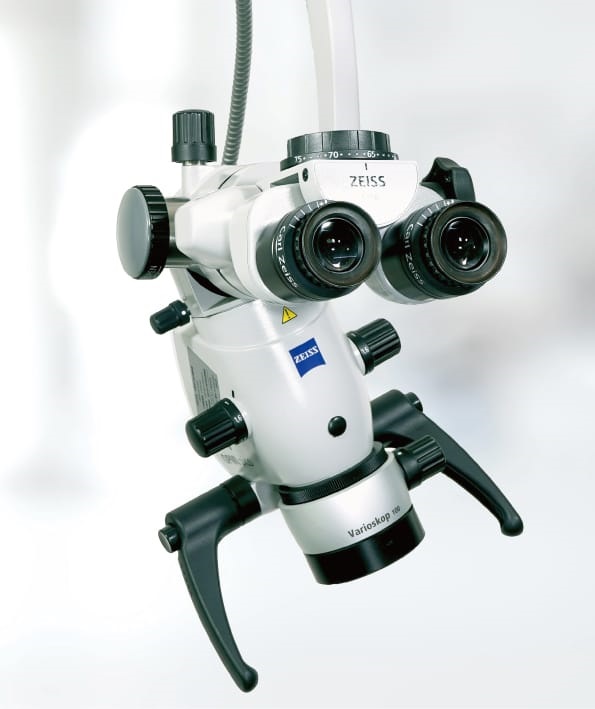
At Aspen Dental Care, every single treatment — from a root canal to a veneer preparation — is performed under an advanced dental operating microscope. Magnification from 5× to 25× reveals what the naked eye simply cannot see.
The Technology
Microscopic dentistry uses a high-powered dental operating microscope (DOM) mounted on an articulating arm to illuminate and magnify the treatment field up to 25×. What looks like a uniform surface to the naked eye reveals intricate anatomy — accessory canals, micro-fractures, hidden decay margins, and tissue planes — under magnification.
At Aspen Dental Care, this is not an add-on for complex cases. Every treatment, for every patient, is performed under the microscope. It is our standard of care — because precision shouldn't be optional.
Your Visit
From first consultation to final follow-up, the microscope is central to every step.
Our Services
We don't reserve the microscope for "difficult" cases. It is used for every procedure — giving every patient the highest possible standard of care.
Root canals are perhaps the single greatest beneficiary of microscopy. At 25× magnification, accessory canals, calcified passages, missed canals, and fins — invisible otherwise — are located, cleaned, and sealed with certainty. The result: a root canal that is thorough, comfortable, and built to last decades.
Under the microscope, even the smallest cavity is fully excavated without touching healthy enamel. Bonding layers are applied with perfect adaptation, and the final restoration is sculpted and polished to a seamless finish.
Veneer preparation demands precision at every micron. The microscope allows us to prepare the minimal enamel necessary, verify perfect margin placement, and ensure the final porcelain bond is optimal — for veneers that last a lifetime.
Crown preparation under the microscope means precisely controlled taper, perfectly placed margins at or just below the gumline, and a prep design that maximises retention while protecting the pulp. Temporary and permanent crowns are fitted under visual verification.
Microsurgical periodontal techniques use finer instruments and smaller incisions than traditional surgery, resulting in dramatically less pain, swelling, and healing time. Flap design, root debridement, and suturing are all performed at microscope level.
Microscope-guided implant surgery ensures the osteotomy site is prepared with optimal angulation, precise depth, and perfect relation to adjacent anatomy. Implant placement, abutment seating, and soft tissue management are all performed under visual control.
Under the microscope, the periodontal ligament space is clearly visible, allowing instruments to be guided precisely between the root and alveolar bone — preserving the socket and surrounding bone for future implant placement.
Children's teeth have thinner enamel and closer pulp chambers — making precision even more critical. Microscopy allows us to treat children with minimal intervention, reducing anxiety, chair time, and the risk of accidental pulp exposure.
Before any whitening or smile makeover, we use the microscope to assess enamel integrity, existing restoration margins, and gum health — ensuring the treatment plan is safe and will deliver predictable results.
Why it Matters
The level of visual detail directly determines the quality of treatment possible. See how we compare.
Patient Benefits
Every cut, every fill, every canal is performed at sub-millimetre accuracy. The microscope transforms dentistry from an art of estimation into a science of certainty.
By seeing exactly what needs to be removed, we take only diseased tissue — preserving healthy enamel, dentine, and pulp. Your natural tooth stays stronger, longer.
Microsurgical techniques use smaller incisions, create less tissue trauma, and allow more controlled tissue handling — translating to significantly less post-operative discomfort.
The microscope connects to a 4K monitor so you can see your own treatment in real time. No more mystery — just clear, transparent dentistry where you are fully informed.
Restorations placed with microscope precision have better marginal seal, superior aesthetics, and longer clinical longevity — saving you time, money, and repeat procedures.
Conditions that would be missed at naked-eye examination — micro-cracks, early interproximal lesions, cracked cusp syndrome — are identified and managed before they escalate.
Your Journey
From the moment you walk in to the moment you leave, our microscope-first approach means you receive treatment that is more thorough, more comfortable, and more transparent than you have ever experienced.
Questions
Book a consultation and discover what precision under the microscope can do for your smile — and your peace of mind.